The Defense Industry Is Having a Moment

I spent the first seventeen years of my life in Quincy, MA, never far from Fore River Shipyard and its looming crane, Goliath. Founded by Thomas Watson, the famed assistant of Alexander Graham Bell, Fore River became a leading producer of naval ships while building several hundred vessels for the US Navy across the World Wars and Cold War. Though the yard was shuttered in 1986, six years before I was born, Goliath remained until 2008 when it was finally dismantled and sold. A towering reminder of Quincy’s shipbuilding roots, I remember being able to see the crane clear as day, two and a half miles away at the Granite Place shopping plaza.

It’s a strange thing to stare at your future without realizing it, but that is in fact what happened. As fate would have it, my first job following college was with General Dynamics, the former proprietor of the Quincy shipyard. I was hired by the Electric Boat division in Groton, CT, one of two makers of submarines for the US military, where my job was to build cost reports to show the Navy what we were doing with their money. My decision to head south and work on spreadsheets in a Connecticut cubicle farm was out of sync with many of my friends, who took jobs in Boston and New York. The fact is in 2015, the defense industry was not a cool place to be.

But something’s changed; people are paying attention to defense.  If there’s one place with a perpetual soft spot for commando culture, it’s Hollywood, and are they ever embracing it right now. Top Gun: Maverick, which started showing in May, has grossed $1.4B at the box office, and the meter is still running. Yes, that number is a little shy of the $8B the Navy pays for a new Columbia Class Submarine, but it’s a lot by most standards, and a good indicator that Hollywood and its consumers are “down” with defense. Who doesn’t love the shot of an Abe Lincoln bobblehead nodding approvingly from the bridge of his namesake carrier as fighter jets blast off the flight deck?

A little further north, Silicon Valley is getting down too. While the Valley has roots in defense, its relationship with war is complex, and not always cordial, as evidenced by Google employees’ protest of Project Maven in 2018. The bottom-line is many Americans, including those with a technical bent, find difficulty in reconciling our wars, and so too the technologies that drive them. But the funny thing about patriotism is it’s durable, and potent. And the technical challenges to maintaining global military leadership in the 21st century are steep, fascinating, and piquing the interest of young engineers. Artificial intelligence, cybersecurity, and space superiority are all at the forefront of the conversation. In fact, Elon Musk’s SpaceX turns $2B a year in revenue, largely from government contracts, and is successfully demonstrating that one can wear jeans to work while solving problems of national interest.

While top engineering talent has migrated toward defense, the tech investment community has not stood by idly. Venture Capital firms including household names like Andreessen Horowitz are actively investing in defense and crafting thought pieces on the industry’s importance. And the investment dollars are piling up rapidly. Since 2011 six defense startups, led by Palantir, have achieved $500M valuations. Four of those companies have achieved the milestone in the last 18 months. For context, a $1B valuation signals “Unicorn status” in VC parlance. A new crop of defense companies and brainpower is arriving atop a wave of capital.

All of this spotlight on defense—across movie studios, engineering labs, and investment meetings—is well warranted. Four years ago, the Pentagon underwent the equivalent of scene change. The 2018 National Defense Strategy pivoted focus from the War on Terror, which dominated the previous two decades of defense policymaking, to Great Power Competition—the idea that the US military is no longer in a league of its own, and in fact has emerging “near peer-threats” in China and Russia. The 2018 NDS also spoke forebodingly of tensions in eastern Ukraine.

Ultimately, the global ideals that national security endeavors to protect—freedom, security, and prosperity—are at risk every day, and our ability to uphold them comes from a collective vigilance. So, if you’re a film fan, engineer, venture capitalist, or anyone at all, now’s a good time to pay attention. 

Matthew Doyle is a business development manager at L3Harris Technologies in Somerville, MA. His commentary on business and the economy and has appeared in The Providence Journal and other outlets. Views expressed in his writing are his own. He can be reached on Twitter @MatthewJDoyle_.

What Does a Pandemic Do to the Economy?

The story of jobs in Massachusetts is a complex one. Just a year ago, the state’s economy roared, the unemployment rate scraped below 3%, and experts assured that if a recession was coming, it wouldn’t be anytime soon. And then came COVID-19. The virus that first made landfall in Massachusetts last February has since claimed the life of the 13,000 residents while the state has endured a series of stay at-home advisories, work from home mandates and school closures. But what does it all mean for job growth?

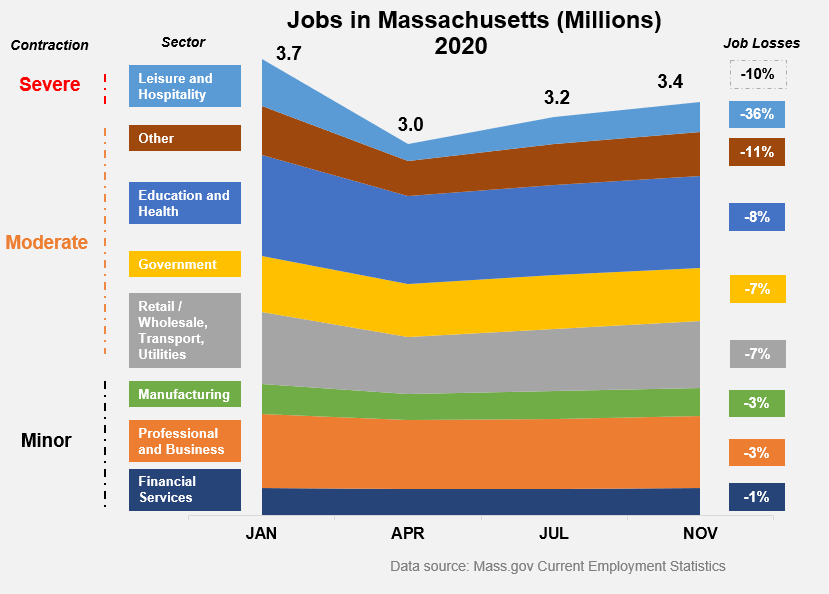
The year 2020 was an ugly one for the economy, and April was particularly horrific. The unemployment rate jumped six-fold from 2.8% to 16.2% as layoffs spread rapidly across the state. Spring brought promise and healing, however. The weather warmed, the virus retreated and Governor Charlie Baker initiated his four-phase reopening plan in May. From May through September, Massachusetts added an average of 64,000 jobs per month. Unfortunately, the recovery is not over. Fall and winter have coincided with a spike in infections, the pace of hiring has slowed, and the degree of economic hardship varies widely across walks of life.  

The economic impact of COVID-19 on Massachusetts is a tale of two Commonwealths. There are those who endure the pandemic’s pain, and those who do not. Oft-discussed “white collar workers”—those occupying financial, managerial and business services roles, which account for a quarter of jobs across the state—have been largely insulated against the downturn. The digital nature of desk jobs has only accelerated during the pandemic thanks to the adoption of connectivity tools like Zoom. Manufacturing jobs also rebounded strongly during the summer, and the sector is just 7,000 jobs shy of its pre-COVID employment total. Other corners of the economy haven’t been so lucky.

Education and healthcare, classified as a single industry by the Bureau of Labor Statistics, employs 1 in 5 Massachusetts workers, but shed 8% of its workforce during 2020. A slow bounce back in healthcare has been partially offset by education jobs, which have remained stubbornly flat following a 13% paring in April.  The number of retail and wholesaler jobs in the state remains 7% below its January 2020 peak; employment gains plateaued this fall following strong hiring in the spring and summer. State and local government jobs in the Commonwealth remain off by 7% from last year’s highs; the dip, likely lasting, is driven in part by closure of 2020 Census efforts. 


Leisure and hospitality, which includes Boston’s cherished dining scene, along with the vibrant arts and entertainment community, sits in a tier of economic misery on its own. The industry, which employed 380,000 residents early last year, was forced to lay off a staggering 75% of its workforce during March and April, as dining and travel restrictions came to bear against a surging virus. Over a third of leisure and hospitality workers remain unemployed even after proprietors reupped staffing through the spring and summer. The Massachusetts Restaurant Association estimated in September that 20% of the state’s eateries have closed permanently. 

The passage of recent bills in the Statehouse provides some support. In November, Governor Baker announced a $50 million economic stimulus providing relief to roughly 900 small businesses. The program received ten times as many applications. In December, Massachusetts announced a second stimulus for small businesses totaling $670 million. The latest measure, which allocates $75,000 per company, or three months’ expenses, could provide relief to nearly 9,000 businesses across the state. A balanced approach to grantmaking that views businesses through the lens of hardship while considering the company’s potential contributions to the economy is critical to maximizing the impact of the funds.

But the question remains: when will the economy go back to normal? The Massachusetts unemployment rate sits at 7% heading into the middle of winter, as the number of COVID cases remains elevated following the holidays. Assuming that hiring remains modest through the winter—10,000 jobs per month—and job gains in the spring and summer mirror those from last year as the vaccine is distributed and the state returns to a typical cadence of life—60,00 jobs per month—the Commonwealth can expect to return to pre-COVID employment levels sometime in the late summer. And for the many months in between, the degree of economic pain felt by those in the Bay State rests largely on occupation.

//

Matthew Doyle is a business development manager at L3Harris Technologies in Somerville and a graduate of the University of Rhode Island. His writing on business and the economy has appeared in The Providence JournalProvidence Business News, and The Day. Views expressed in his writing are his own. Follow him on Twitter @MatthewJDoyle_.

Rams & Bears: University of Rhode Island Meets The Big Short

The year 2020 has been quick to provide crises of both the pandemic and social variety. But let us not allow the discomforts of fresh disasters to dampen our memories of the old ones. This year marks the tenth anniversary of The Big Short, Michael Lewis’ best-selling post-mortem of the financial crisis. The Big Short served as a sharp portrait of the financial instruments that rocked the global economy, and the characters who found fortunes in the wreckage. Likely the most insightful book on the financial meltdown, it is far and away the most entertaining.

Less obvious, though of particular interest to those in southern New England, are the book’s linkages to the University of Rhode Island. A typical state school with a predisposition towards STEM, URI ranks 166thth among national universities and has been the state’s flagship school since its founding in 1917. Its College of Business, my alma mater, is home to solid accounting and finance curriculums, and sends a healthy number of students to the Big 4 accounting firms, though fewer to banks. In a given year, however, a few students with sharp pencils and sharper elbows can typically land analyst roles on Wall Street.

To understand The Big Short’s connections to URI, it’s helpful to review the timing of some key events. Early in the book, protagonist investor Steve Eisman encounters a Deutsche Bank salesman named Greg Lippman, who comes baring a warning.  Large numbers of Americans had acquired unaffordable mortgages, Lippman argued. The investment banks then took those mortgages, bundled them together, and sold them off to unsuspecting investors. When homeowners could no longer afford their payments, housing-linked securities would freefall, and the effects to the financial system could be disastrous. Lippman’s solution? Place a wager against the US housing market—through him of course—and become enormously rich.

After digging through the data, Eisman’s team found merit to Lippman’s recommendation; the housing market was teetering, catastrophe near. Steve Eisman faced a gnawing question, however. If the housing market was in deep trouble, who was foolish enough to be betting on its longevity? As it happened, other investors were asking Greg Lippman the same question, and he decided to hold a dinner in Las Vegas to help answer it. As with many stories, particularly those involving bets, The Big Short is full of winners and losers, and URI has alumni on both sides of the coin.

Tasked with managing housing linked investments for large investors like pensions and insurance companies, Wing Chau—quickly identified as a graduate of URI and Babson—was brought to dinner to play the fool. And seated beside Steve Eisman, he played the role beautifully. Chau, surprisingly to Eisman, was happy to continue betting on the US housing market. After all, his compensation was driven mostly by how much money he managed for his clients, not how well he managed it. The more assets under his purview, the bigger his fee, Chau gloated. Eisman was stunned. 

Chau, who is painted as a portly purveyor of financial calamity for several pages, sued Lewis for defamation in 2011. He lost. Chau himself was sued by the SEC in 2008 for neglecting his fiduciary duties—his legal obligation to place his investors’ interests above all—and settled for a number well into the seven figures. Though the blame does not belong to money managers like Chau, exclusively. The investment rating agencies, S&P, Moody’s, and Fitch, performed horribly, too. Housing investments during this time were routinely marked as investment grade, while according to Eisman, many were anything but.

Fear not, the University of Rhode Island has a champion in the story, too. So rare was the money manager who put his chips against the US housing market in 2008 that Lewis estimated the number to be fewer than twenty. While most were based in New York City, several others were scattered across the US, including one hedge fund in Massachusetts. As Greg Lippman crisscrossed the country, trying to convince investors that things were falling apart, he made a stop in Boston and found himself across the table from a young investor named Jesse Baker.

I first came across Jesse at a career day alumni panel during my undergraduate years at URI. To be clear, he was on the panel, to dispense advice to lowly students, and I was in the audience, probably underdressed. Jesse was spectacled and—aside from a subtle barb at the fixed income specialist on the panel—quiet while awaiting his turn to speak. And when he did speak, his pedigree did most of the talking. After URI, Jesse joined Goldman Sachs, cycling through investment banking and private equity groups in New York and London, before heading to Harvard for an MBA.

Jesse was hired as a hedge fund analyst following Harvard, and shared his account of watching the crisis unfold firsthand. Sure enough, a salesman had come to the office, trumpeting notions of financial mayhem; Lippman offered Jesse’s group the same deal he’d offered Eisman, an instrument to bet against the housing market, in return for a fee. During the meeting, Lippman showed a graph of US housing prices; the trend mirrored that of real estate prices in Japan prior to the country’s devastating decline of the ’90s. After some additional number-crunching, Jesse’s team was sold. The firm went short, awaiting Armageddon, and riches.

With 18,000 students on its leafy campus, a large school like URI is bound to have alumni in the headlines for the right and wrong reasons. Of all villains, Michael Lewis chose Wing Chau—an unknown New Jersey money manager with a URI economics degree—as the poster boy for bad decision-making and misaligned interests underpinning the crisis. More improbable still, in a nation of 320 million, the number of people who spotted and bet on the housing crash is not far beyond double digits, and one went to URI. Armed with a Rhody finance degree and penchant for Excel, Jesse Baker found himself amid a short reserved for the smartest of smart money.

The Big Short’s linkages to the University of Rhode Island thread a global discussion directly into our local community while also affirming an old truth. People, financial professionals and otherwise, serve as ambassadors for their institutions, past and present.

Matthew Doyle is a business development manager at L3Harris in Somerville and a graduate of the University of Rhode Island. His writing on business and the economy has appeared in The Providence Journal, Providence Business News, and The Day. The views expressed in his writing are his own. Follow him on Twitter @MatthewJDoyle_.

Quincy Center Remade: Triumphs or Tribulations

Quincy is a place of distinct character. Situated between Boston and its South Shore, the coastal city of 90,000 is a unique collision of urban and suburban influence. Traditionally working-class with pockets of unassuming affluence, Quincy’s economic roots are industrial while recent decades have seen the City’s residential complexion shift towards that of the office worker. And of course, two United States Presidents lay buried beneath its well-trodden streets.

In the middle of this landscape is Quincy Center, an assortment of city government, commerce, historical sites and private residences. After moving from Quincy as a teenager in 2009, my visits to Quincy Center were scarce. Stately and tired, it had the dinge and frenetic pace of a city center without the upside. It was anathema to name-brand retailers, short on quality dining, and without attractions beyond a shabby movie theatre. Nor was it the first place you’d want to find yourself at night. For all of Quincy’s strengths, its downtown was not one.

So, when I began to hear tales of Quincy Center’s turnaround, that it was becoming a hot spot for young people, I was intrigued. And though the changes have been well-reported, I returned recently to find the Quincy Center of old fading away. Familiar landmarks like the Bethany Congregational Church, with its menacing gargoyles, and the unremitting Granite Trust building have been joined by soaring luxury apartments and trendy eateries. There is even a greenway replete with fountains and trees on what was a congested street.

The redevelopment efforts have a clear potential to change the identity of Quincy Center and that of the city itself. Modern residential builds and a burgeoning dining scene are bringing a new sense of life to the area. Young professionals and businesses seeking cheaper alternatives to Boston and Cambridge have taken notice, and more will follow suit. On the other side of the coin however are Quincy Center’s small business community and residents, who are at risk to be trampled by the stampede. The changes afoot should be considered diligently.

Yes, there are benefits to having greater numbers of young people living and working in Quincy. A new generation brings an energy and thirst for progress not yet evaporated by thirty years sitting at a desk. And a Deloitte survey from last year found that today’s young professionals favor objectives that emphasize job creation and societal improvement to those prioritizing sales and profit. That mindset is a necessary precursor to fighting for an equitable Quincy and driving a positive approach to community development.

And to be fair, a growing corporate presence in Quincy doesn’t sound all bad either. Quincy Center, home to the headquarters of Stop & Shop, the grocery giant, and Presidents Place, which leases space to Harvard Vanguard and Quincy College, has long-possessed corporate footprints while falling somewhere short of critical mass. The center’s ongoing facelift, cheaper-than-Boston overhead and Red Line proximity might just be enough to draw the kinds innovative businesses to push Quincy through the final phase of its decades-long economic rebirth.

The revival, however, could spell trouble for life-long residents and long-time businesses of the city. Affordable housing in Quincy Center and other neighborhoods is a reported problem already, one sure to be exacerbated by an influx of high-salary professionals. Renters may be forced elsewhere, along with the city’s millennial natives, who have watched home prices double over ten years. Small businesses face a parallel concern. As demand for commercial real estate increases, so too will rent. Many colorful businesses that have long represented the upside of Quincy Center’s character—KC’s Sportscards, Nick’s Pizza, and the outlandishly painted tropical fish store—are still standing. Let’s hope they remain so.

A moment of stark contrast between new Quincy Center and old unfolded toward the end of my visit. After mazing through side streets, I arrived at the entrance to West of Chestnut, the chic and towering residential complex erected in 2016. Across the street was Sully’s—the longstanding local watering hole known for its eponymous neon signage—forlorn and shuttered. My moment of reflection was soon broken as a twentysomething darted from the apartment to collect his Amazon groceries.

Quincy Center is changing rapidly. New residential buildings, improved infrastructure, and a spate of dining establishments have roared into the downtown, creating a lively and urbane atmosphere once reserved for points north of the Neponset River. Although a young workforce and increased corporate presence carry social and economic promise, public officials would do well to push harder on affordable housing while exploring measures to protect small businesses from soaring rents.

Vice, the New Face of Media

The Internet jabbed a knife into legacy media, and millennials twisted. Millennials are America’s largest generational cohort and consumer group. The problem is certain companies—especially the media titans—were never sure how to approach the defiant, smart-phone wielding bunch. They don’t pay for cable TV. News is a birthright, not an expense. The audacious idea that they would pay for ad-riddled television was met with cord-cutting. And only 40% of millennials pay for a news subscription. These developments are chilling to media companies and their corporate counterparts who fork over billions in advertising dollars.

It follows that a media company with the superpower to influence and engage millennials might be worth something.  Vice Media, which started as a Montreal–based punk rock magazine in the 90’s, is a household name among Gen Y. The digital media darling churns out edgy and millennial-centric news and content—from documentaries on drug use in the US to reporting on wars in far flung corners of the world—across a bevy of mediums including its websites and television station as well as social platforms YouTube and Snapchat. Over the summer TPG, the seminal buyout group, invested $450 million in Vice. The investment values the company at $5.7 billion, nearly double what the New York Times would garner in a sale today. And Vice is worth every penny.

But why is Vice the answer? Their billion dollar CEO looks like a House of Blues Bouncer. They publish lewd headlines about German sex dolls and generally possess a penchant for embracing political incorrectness. The company’s smash mouth style has done little to curb its skyrocketing valuation nor has it deterred industry incumbents like Disney and Rupert Murdoch from hurling financing at the upstart. The centerpiece of Vice’s value proposition is that it understands millennials in a deep, genuine way that mature companies both inside and outside of media do not. For the right price, Vice leverages its Gen Y savvy to help make other products cool too.

Vice’s differentiator is branded content, advertising that weaves together a legitimate, well-reported narrative about a brand or product. An example is Nike paying for a video detailing the history of its famed SB Dunks. It’s not wrong to say Vice is doing the work of Madison Avenue; Vice helps brands build an image and tell a story. From a business standpoint, Vice’s reliance on branded content isn’t a bad thing. Vice does not suffer from the illusion it will make money selling news. The WSJ reported most of Vice’s $800 million in projected revenue for 2016 would come from branded content. It doesn’t hurt that Vice has sharpened its journalistic credibility, either.  Rugged reporting assignments have included embedding a reporter in ISIS and sneaking founder Shane Smith into North Korea to film a covert video series.

Critics, including Vice’s defunct digital rival Gawker, have asserted Vice is capturing the attention of hip consumers and selling their attention to the very corporate monoliths those consumers eschew.  Shane Smith vigorously denies that corporate customers dictate Vice’s storytelling.  The truth is an investor doesn’t care where Vice’s allegiances lie. Vice has 25 million monthly visitors on its websites and access to another 25 million through sites that pay Vice to handle ad sales. In comparison, the NYT has about 80 million monthly visitors. Vice helps connect those millennial eyeballs to hip brands like Nike and unhip brands like Dell. It also teams with legacy media companies like CNN to help them get a seat at the cool table.  And for its services Vice earns $800 million a year in revenue.

Using the $450 million from TPG, Vice plans to pursue scripted programming and international expansion. However, solid reporting and lofty corporate ambitions aren’t enough to bring a media company to the Promised Land. But mix those attributes with a knack for understanding millennials, and an ability to turn that understanding into revenue, and the new face of media begins to emerge. Millennials are elusive, but their buying power is too large to ignore.  Companies, media and otherwise, must find ways to appeal to them.  For now, Vice owns the keys to the kingdom, and rightfully, a $6 billion dollar price tag.

Is Gary Cohn the Man for the Job?

Gary Cohn, the former Wall Street trader and second-in-command at Goldman Sachs, has emerged as a contender to succeed Janet Yellen as Chair of the Federal Reserve come February. Cohn currently serves as Director of the National Economic Council, a post he was granted following President Trump’s election in November.  Cohn, who helped lead Goldman’s tactful glide through the global financial meltdown, is as credentialed as anyone on Wall Street. His background however, which stands in stark contrast to that of the prototypical Fed Chair, presents a mix of challenges and upside.

First, Gary Cohn is not an economist. The primary role of the Federal Reserve is to craft monetary policy that ensures the American economy runs soundly. Unsurprisingly, the Federal Reserve is packed wall to wall with economists. A PhD in economics seems to have become prerequisite for the Fed Chair seat, as well as for the regional fed Chair seats Cohn would be tasked with leading. Fed heavyweights tend to come from academia or the government, though exceptions do exist. Three of the twelve current regional Chairs are non-PhD, ex-bankers. Cohn however, if nominated, would be the first Fed Chair to come from industry in 40 years, and the first without graduate education in 70 years

Cohn’s industry experiences as COO of Goldman Sachs—leading teams, evaluating and managing risk, and navigating market crises—would be valuable to him as Chair. The liability for Cohn lies in the fact that his background is not deeply technical, while at times the nature of his work could be. There is little question that Cohn could quickly absorb a primer on regression analysis. However there is a steep learning curve to leading and debating colleagues who have been doing it for 20 plus years. Cohn’s leadership capabilities could be beneficial in corralling differing views within the Fed; however he will need to rely heavily on his team in grappling with the technical nuances of central banking.

Second, the corporate culture in which Gary Cohn was reared and excelled is vastly different from that of the Federal Reserve.  Big, bald and direct, Cohn was known to prowl the Goldman trading floor, plant his foot on a trader’s desk, and demand an update on the markets. Although few are holding their breath on a story where Cohn hoists a shoe onto the desk of the vice chair, the cultural differences go far beyond management style. Gary Cohn is a trader, and traders often rely on gut and intuition to make tough calls. A marquee characteristic of both Cohn and his former Wall Street employer is decision-making that is both quick and bold. And as of late, the Fed has been neither.

During its quest to raise interest rates, the Federal Reserve has been methodical and deliberate. The cadre of policymakers continues to face the conundrum of strong employment and low inflation; the federal funds rate sits at 1.25% nearly ten years removed from the financial crisis. On the one hand, the presence of a forceful decision-maker atop the Fed could be a great thing for an institution that has faced criticism for analysis paralysis and data dependency. On the other, a gunslinger bent on the speedy escalation of interest rates runs the risk of tipping the economy back into recession. The balancing act for Cohn will be forcing some direction into the interest rate discussion while knowing that the Fed operates in a world where too much direction can be a bad thing.

Cohn’s ascent serves as a reminder that we live in a country where a dyslexic boy from Ohio with heap of a drive and bachelor’s degree can become the world’s preeminent central banker.  Installing the ex-trader as head of the Federal Reserve would be a policy experiment of mammoth proportions. Some aspects of Cohn’s background—strong leadership and an intimate history with the markets—could be highly advantageous to running one of the world’s most influential institutions, one that affects lives from Wall Street to Main Street. With that said, it is fair to wonder whether a brash play-caller without formal economics training is well-suited for the world of monetary policy. Should Mr. Cohn relocate his office to Constitution Ave in February, we will have our answer.

Hoodies, Handcuffs & High Finance: Martin Shkreli

The coming of age for millennials in America, or those born between 1980 and 2000, seems to have happened swiftly. They number 75 million. They have surpassed Baby Boomers as the largest cohort both in the workplace and in the country at large. While society continues to associate millennials with puberty and hooded sweatshirts, the reality is the older end of the generation is well into its thirties and far-removed from the orthodontist. As noted by London Business School, a great deal of time has been spent pondering how to best lead millennials. Conclusions point toward a determined and tech-savvy bunch with a penchant for pushing change. Less flattering diagnoses also reflect a group that is entitled, vain and not especially loyal to employers. The subjects meanwhile have proven uninclined to wait for direction.

Millennials are impactful. They run public companies, win Nobel Prizes, and get elected to Congress.  A few also go to Wall Street where, through the years, the land of iconic wealth, avarice and big deals has seen its share of robber barons. But never have the two labels—millennial and rogue financier—been so flawlessly merged into a single character, until now. Enter Martin Shkreli, the 32 year old hedge fund manager turned pharmaceutical entrepreneur arrested for securities fraud in December. While his improbable rise from have-not to high finance lends credence to millennials’ reputation as go-getters, his public persona—a greedy, brash social media troll with a knack for irritating Hillary Clinton—has done little to dispel their image as snot-nosed narcissists. Congratulations Martin Shkreli, you are the first ­­millennial Mega Villain of Wall Street.

His early life reads like Good Will Hunting with more chess and fewer street fights. A first generation American reared in blue-collar Brooklyn, Shkreli rocketed into finance, starting two hedge funds before his 27th birthday. He was quickly recognized as a formidable activist investor, known for scathing blog posts of biotech companies he was short. Soon he would reverse course. In 2011 Shkreli took “the ultimate long position”, founding Retrophin, a biotech startup with the mission to battle “rare and life-threatening diseases.” In 2012 he was afforded a spot on the Forbes 30 under 30 in Finance. For a brief while Shkreli was loved; David armed with a big mouth and a spreadsheet, destined to defeat the Goliath CEO’s of the evil drug industry. Relentlessly ambitious, adept at using technology to catalyze change and armed with an apparent desire to tackle social issues, Martin Shkreli represented the tantalizing millennial upside that, at times, signals a generation ready to right the world.

Often times, the villainous and derided do not begin the story as antagonists. Harvey Dent is no stranger to Wall Street, from the decay of Bernie Madoff’s $36 billion dollar lie to the implosion of Enron. In the early hours of December 17th, nearly three years to the day of his 30 under 30 designation, a hooded Mr. Shkreli was escorted from his Murray Hill apartment donning manacles. The arrest was not an epochal moment, but rather the punctuation on a gradual ascent to mega-villainy. Standing before a judge at the Federal District Court in Brooklyn, Shkreli appeared at ease. While brazen behavior is not a new fad among corporate crooks, his attire—a black V-neck and sneakers—was a notable departure from the four-figure uniforms of his Wall Street predecessors at battle with the law.

Despite his early achievements as the biotech boy wonder, Shkreli developed a magnetic-like ability to draw critics long before the Department of Justice came wielding a federal indictment. In 2011 Shkreli’s hedge fund, MSMB Capital, lost $7 million betting against the stock of Orexigen Therapeutics, effectively wiping out his investors. Consistent with millennial tendency to bend the truth about poor performance, Shkreli told investors that things were fine, and he had in fact doubled their money. The move put him in the precarious position of having to pony up funds he didn’t have, funds he would eventually siphon out of Retrophin. The charade lasted long enough for Shkreli to cover his obligations at MSMB, but Retrophin investors eventually caught wind of the stunt, followed by its board, who showed Shkreli the door in 2014. In true millennial form, Shkreli took to social media to vent his frustrations.

While details of his ouster from Retrophin were still unclear, TheStreet crowned Shkreli Worst Biotech CEO of 2014. Though disdain for the young parvenu was still contained largely to industry, his time in the shadows of Wall Street would be short lived. It didn’t take long for Shkreli to kick off his second entrepreneurial venture, Turing Pharmaceuticals. It was here that Shkreli set the stage for his leap to notoriety. In November 2015, Turing acquired the rights to Daraprim, a drug used to treat infections in individuals with HIV. Shkreli soon raised the price of a single pill an astronomical 5,000% from $13 to $750, catapulting himself into the crosshairs of Presidential candidate Hillary Clinton. The New York Times estimated the price hike—a practice oft-implemented by smart money-backed drug companies—could cost patients hundreds of thousands of dollars. “1b[illon] here we come”, was Shkreli’s boastful message to a colleague.

In September, Mrs. Clinton launched her assault. Clinton laid into Shkreli at a town hall meeting in New Hampshire, called for investigations into the price hike, and, representative of the fast-growing number of elderly on social media, took her 68 year-old fingers to the keyboard to serve up a shot on Twitter. Shkreli, in perhaps his archetypal act of millennial defiance, dismissed the then-Democratic frontrunner with a brief “LOL” – the three letter phrase branded into the e-vocabulary young people that rose to prominence during the time of AIM chatrooms and T-Mobile Sidekicks. BBC quickly named Shkreli the most-hated man in America, followed by The Daily Beast.  In December, to ensure he had adequately appalled all corners of American society, Shkreli purchased the lone copy of Wu-Tang Clan’s latest effort for $2 million with no intent listen to the album but rather to “keep it from the people.

Martin Shkreli began accumulating mega-villainy stature long before his December 17th arrest. His chicanery at Retrophin coming into public view was more or less icing on the cake for the millennial lighting rod. There is a likeness in his situation to that of the fallen banker, Michael Milken. The toupee-sporting Junk Bond King of the 80’s grew wildly unpopular well before his insider trading arrest, thanks to his practice of arming corporate raiders with billions of junk debt to stage hostile takeovers. Though not illegal, the takeovers were regarded as dirty corporate practice, much like the Daraprim price hike. It is as easy to imagine Mr. Milken’s bewilderment listening to a Wu Tang album as it is unlikely that he has ever owned a V-neck. The sophisticated finance scoundrel is not a new breed. Shkreli is just the latest model.

“You could go down in history as the poster boy for greedy pharmaceutical executives, or you could change the system.” Those were the words directed at Shkreli by Congressman Elijah Cummings. In a broader sense, it is advice that can be taken to heart by all millennials. They are indeed a generation capable of propelling great change. However they must ensure their tendency to cut corners does not undermine their willingness and capacity to solve problems. They must also learn strike a balance between drive and humility. Martin Shkreli embodies the paradox well. Misled investors and burdened patients lie in the wake of his intense ambitions. He remains unapologetic. Perhaps if it’s not too late, Mr. Shkreli can find his way back to square one. Otherwise, the millennial wunderkind may be facing checkmate.

Small State, Big Problem: Rhode Island’s Innovation Gap

In 2007 Dr. Ken Yang, an engineering professor at the University of Rhode Island, filed an application with the United States Patent and Trademark Office. Thus was the beginning of technology that would springboard VeloBit, a computer software company aimed at providing companies with speedier information processing capabilities, or in other words, faster access to data on their servers such as customer records and payroll information. Officially founded in 2010, VeloBit epitomizes a successful startup; a good idea, fast growth, and a pot of gold at the end. However the story of VeloBit is a two-sided fable. The first, certainly, is a story of innovation. The second, meanwhile, is the caricature of a state unable to harness innovation and spur economic rebound.

Ken Yang straddles the line between academia and the startup world. He has been teaching at URI since 1988 in the disciplines of electrical, computer and biomedical engineering. His Ph.D. students have gone on to work for premiere technology companies including Intel and EMC. He keeps busy outside the classroom, too, having started four companies and received ten patents during his time at URI. Those accomplishments include VeloBit, and its foundational algorithm, which improves the performance of solid state drives, a data storage component of computers. Solid state drives are increasingly popular, but at times slow. Yang’s software helped fix the problem, and did so at speeds triple that of its competitors while maintaining an affordable price tag. Ken Yang had a cash cow.

In 2010, a mutual friend introduced Yang to Duncan McCallum, a Boston-based startup guru with degrees from M.I.T. and Harvard Business School who specializes in taking small tech startups, growing them, and selling them to large technology companies. McCallum was won over during a lab demonstration where Yang proved his ability to accelerate information access using an all-software solution. The software eliminates the need for traditional more expensive hardware serving the same function, and as an added bonus, can be downloaded directly by customers via the Internet in under a minute. By the end of fall 2010 VeloBit was off and running, headquartered in Lincoln, MA with a small handful of employees including one of Yang’s former graduate students. McCallum took the helm as CEO, while Yang served as the firm’s technical backbone in the role of Chief Technology Officer.

In the spring of 2011, VeloBit landed financial backing from two Boston area venture capital firms, Longworth Venture Partners and Fairhaven Capital. Both firms focus in the area of high growth technology companies. In what is known as Round A Financing, or the first round of financing following start-up capital, McCallum stated that VeloBit received a “fairly typical A Round”  sum, which often falls somewhere in the single-digit millions. With capital in hand, the small firm began to excel, and was a dubbed a 2012 Storage Product of the Year by Storage Magazine. VeloBit’s “HyperCache” software was judged on criteria including innovation and performance. A TechTarget article noted that VeloBit was fast becoming a stand-out product in its market, despite tough competition. Growth followed. By the second quarter of 2013, VeloBit was in use across five continents with nearly 400 installations.

Amid its successes VeloBit approached bankers at Wells Fargo, and asked them to help identify firms interested in acquiring the feisty start-up. There turned out to be several. However Western Digital, the Fortune 500 computer hardware firm with the recognizable blue and white logo, was the winning suitor. On July 10, 2013, an official press release emerged from Western Digital stating that VeloBit had been purchased, and would be integrated into the Western Digital storage subsidiary, HGST. The sum was undisclosed. However an article the following day by The Register did some guesswork, concluding that the sum was likely “less than $50m and could be around $25m assuming a 5X payout on a guesstimated $5m A-round. But we could be out by a factor of two, or even more.” McCallum has stated that sale “produced good returns for investors and significant wealth for founders.”

Velobit, the brainchild of a University of Rhode Island engineering professor, is in its own right a startup Cinderella story.  Research was commercialized, contributed to society in a meaningful way, and monetized. However just as Cinderella’s stepsisters did not fit the glass slipper, there is a loser in this story too, and it is Rhode Island. The state’s beleaguered economy has long been a topic of concern among citizens and legislators. And The Great Recession did no favors. The state’s unemployment rate rocketed to 11.3% during 2009, up from 5% just two years earlier. Only recently has Rhode Island ended its nine year reign as having the highest unemployment rate in New England, while still sitting a lofty half percentage point above the national average, at 5.5%. The state has recovered only 80% of jobs wiped out during the Recession. In stark contrast, the United States as a whole has regained all lost jobs and reached that milestone nearly two years ago.

However even before the Recession, things weren’t pretty for Rhode Island. Sprawling, shuttered factories have long served as wistful and unsettling reminders of the state’s once fearsome manufacturing prowess. Business friendliness surveys are continually abysmal. For many young Rhode Islanders, this is the only setting they’ve ever seen. What heyday?  Obviously, businesspeople and policymakers have been tasked with the tough problem of how to grow business in Rhode Island. VeloBit is far from the center of the problem, but it is an apt microcosm of the state’s inability to capture a good idea and create growth. And it warrants questioning. How and why did a hot tech startup, born in a lab at the state’s sole land-grant university, sneak out the back door to Massachusetts?

In 2012, University of California, Berkeley economist Enrico Moretti wrote The New Geography of Jobs. He highlighted research showing that one high-tech job, such as a software engineer (like the ones at VeloBit), has the potential to create five more non high-tech jobs in the same city, such as waitresses or cab drivers. If the multiplier does exist, even at a multiple of less than five, it makes the Massachusetts headquartering of a tech company like VeloBit particularly painful for Rhode Island. Though VeloBit is owned by Western Digital, it is still located in, MA, now employs close to twenty people, and is growing. What if VeloBit was instead founded in Rhode Island, and currently staffing twenty people in a Providence office? Moretti’s multiplier suggests the potential for an additional hundred jobs, and Rhode Island could sorely use them.

In exchange for research support, the University of Rhode Island held a partial-ownership stake in VeloBit, and presumably realized financial gains from its sale. Though any sum can be argued a pittance relative to the potential for a successful, Rhode Island-based, job-generating company. So why exactly was VeloBit founded in Massachusetts? The answer, according to Yang, is pretty simple. Duncan McCallum was running the commercial operations of the firm, and he lives in Boston; not rocket science. As many entrepreneurs are aware, venture capitalists don’t stroll down the street doling out wads of cash to techies. Yang was fortunate enough to be introduced to a venture capitalist—someone who could help him commercialize his research and make an impact—and he wasn’t going to complain where they were based. “If the partner is here, we can do it here” Yang said of Rhode Island. “I would like to do it in Rhode Island.”

Innovative ideas should not be confined to certain geographies, nor should the money and brainpower to propel them. Today, VeloBit is a Massachusetts company, and that’s fine. However, to spur growth in the future, Rhode Island needs to do two things.  First, the state should realize that VeloBit and companies like it can be valuable assets in helping to repair a battered, sluggish economy. Say it, out loud. Second, get proactive. A culture needs to be forged, where, when someone has a good idea, there is willing partnership within the state, especially in the private sector, to help them achieve it. There have surely been other instances in Rhode Island similar to VeloBit. At this rate, there will surely be more. Where there is smoke, there is fire. We need to put it out. “We have the talent, we have the people” said Yang. “Rhode Island can be a great state to grow business.”